Why AI-Generated Artwork Fails in Commercial Label Printing
October 27, 2026
While generative AI is a powerful tool for conceptualizing packaging design, it falls critically short on the commercial production floor. Discover the hidden technical and legal risks of using raw AI artwork for physical labels; from low-resolution raster files and CMYK color clashes to overlapping, uneditable text layers - learn why professional vector design remains non-negotiable for print-ready manufacturing.
Generative AI tools like Midjourney and DALL-E have revolutionized digital concept art, allowing brands to rapidly ideate packaging designs. However, transitioning a conceptual AI image to a physical, commercial label reveals significant technical and legal roadblocks. For businesses relying on high-quality product presentation, submitting raw AI artwork directly to a commercial printing press almost always results in rejected files or poor-quality physical outputs.
Here are the primary technical, structural, and ethical issues with using AI-generated artwork for commercial label printing.
Technical and Structural Limitations of AI Artwork
Inadequate Resolution and Missing Vector Graphics
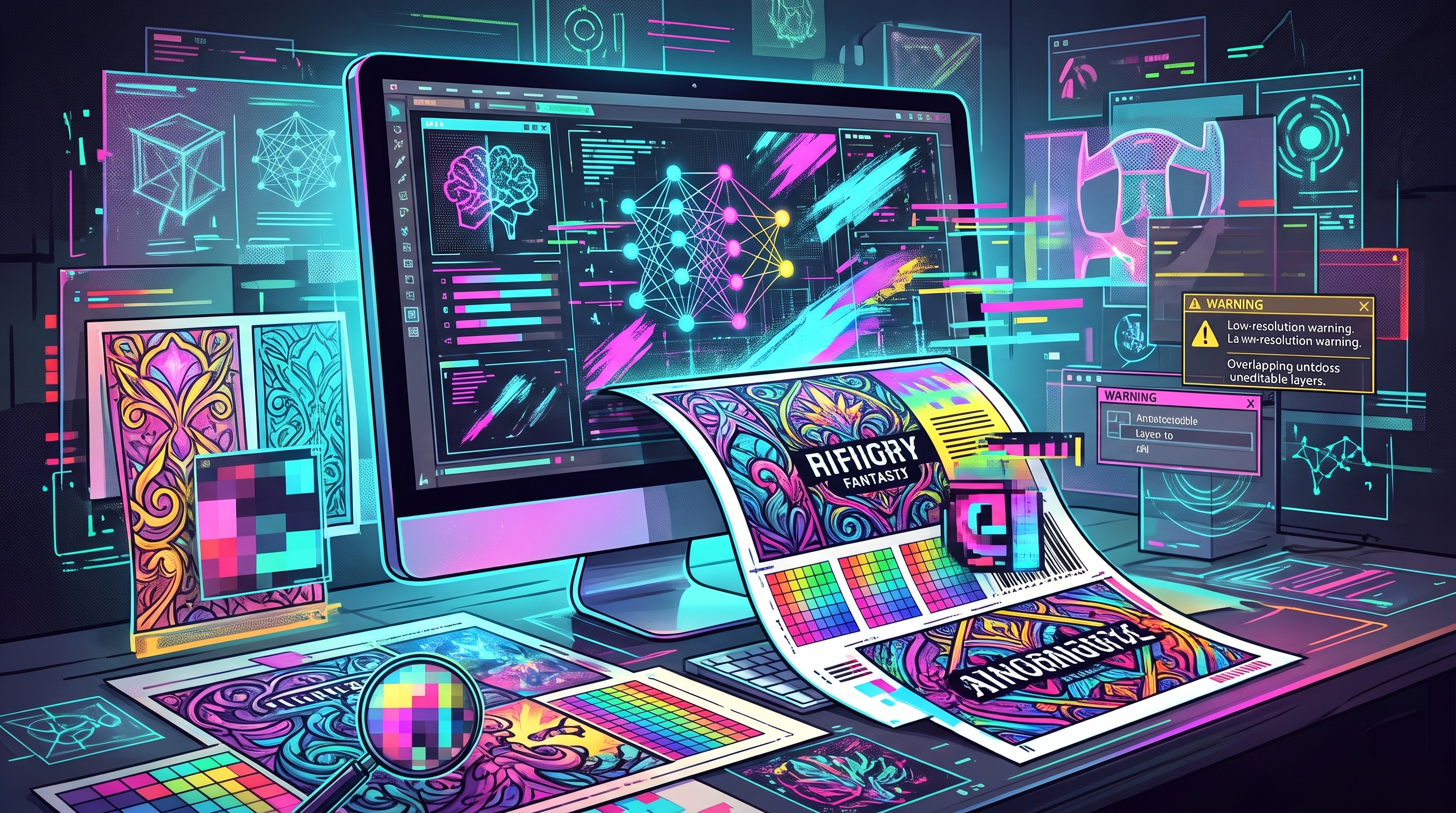
Commercial print manufacturing requires crisp, high-resolution files to ensure barcodes scan correctly and fine text remains legible. Most generative AI platforms output low-resolution raster images (typically 72 DPI), which are optimized for web viewing, not physical manufacturing. Commercial label printing requires a minimum of 300 DPI. Furthermore, AI cannot generate true vector graphics. Without scalable vectors, expanding an AI image to fit different packaging sizes results in severe pixelation.
Flattened Files and Non-Editable Text
A print-ready file requires distinct, isolated layers for backgrounds, brand assets, dielines, and typography. AI generates "flat" images where all elements are baked into a single layer. This means prepress operators cannot isolate the background to adjust the layout. Additionally, AI notoriously struggles with typography, often generating illegible characters. Because the text cannot be highlighted or edited, designers must manually rebuild the typography from scratch.
Incorrect Dimensions and Missing Print Bleeds
Physical label production relies on strict dimensional tolerances and custom die-cuts. AI tools do not operate on exact physical measurements and cannot account for complex aspect ratios. Crucially, AI artwork lacks "bleed"—the extra artwork that extends beyond the cut line to ensure no white edges appear during the die-cutting process. Attempting to force an AI image into a specific die-cut template often distorts the core design.
Color Profile Clashes: RGB vs. CMYK
AI models generate images using the RGB (Red, Green, Blue) color space, which relies on digital screen illumination to create vibrant colors. Commercial label printing utilizes the CMYK (Cyan, Magenta, Yellow, Key/Black) color model. Converting an AI-generated RGB file to CMYK routinely results in a dull, muddy, or entirely shifted color palette on the physical substrate, undermining brand consistency.
Intellectual Property and Ethical Risks
Beyond technical limitations, AI-generated artwork presents significant legal liabilities for commercial brands. Currently, the U.S. Copyright Office and various international bodies have ruled that fully AI-generated images cannot be copyrighted because they lack human authorship. This means competitors can legally use your exact label design. Furthermore, AI models are trained on billions of copyrighted images, carrying inherent moral concerns regarding artist compensation and potential trademark infringement risks if the AI inadvertently replicates a protected brand asset.
Securing Print-Ready Packaging
While AI is a powerful tool for mood boards and internal concept pitching, it is not a replacement for professional prepress design. To ensure your labels reflect the quality of your product, always work with graphic designers who build layered, vector-based, CMYK files engineered to the exact specifications of your commercial printing partner.